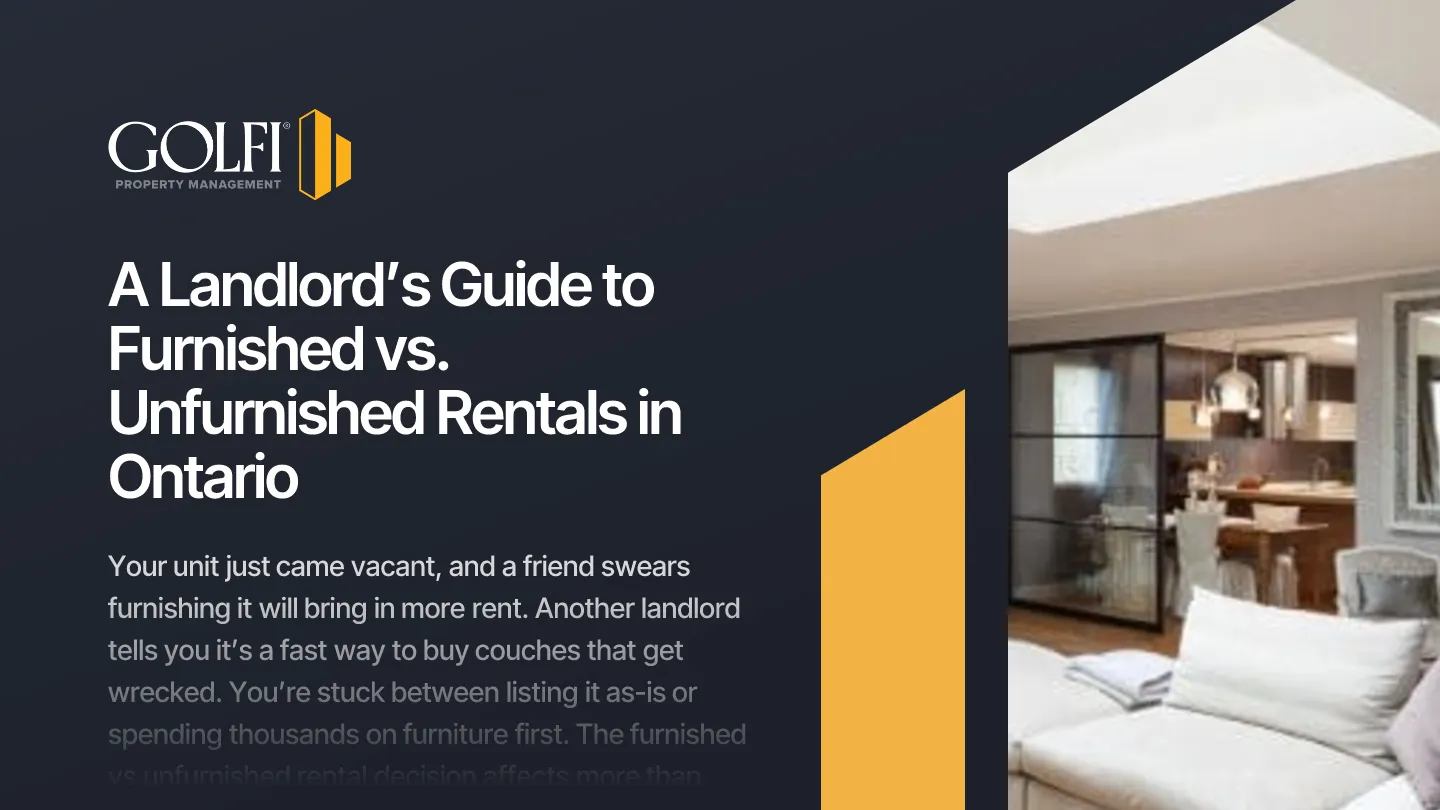
Your unit just came vacant, and a friend swears furnishing it will bring in more rent. Another landlord tells you it’s a fast way to buy couches that get wrecked. You’re stuck between listing it as-is or spending thousands on furniture first.
The furnished vs unfurnished rental decision affects more than décor. It shapes your rent, the tenants you attract, how often you face turnover, and how much work lands on your plate.
In this guide, we break down the real trade-offs for Ontario landlords in 2026, including what the law allows, how Hamilton’s short-term rental rules affect your options, and how to choose the right setup for your property and goals.
First, What Furnishing Doesn’t Change
Many owners furnish a unit hoping it puts them outside normal landlord-tenant rules. In most cases, it doesn’t.
If you rent a furnished unit to someone as their home, the Residential Tenancies Act, 2006 (RTA) generally applies just like it would to an empty unit. That means:
- Rent control rules still apply. Increases are limited to once every 12 months, with 90 days’ written notice, and capped by the guideline for most units (2.1% in 2026, 1.9% in 2027).
- No damage deposits. Even with furniture at stake, you can only collect a last month’s rent deposit (plus a refundable key deposit at replacement cost).
- The tenancy can continue month-to-month. A “6-month furnished lease” doesn’t automatically end after six months. The tenant can stay unless you have a legal reason and process to end it.
- The Landlord and Tenant Board (LTB) handles disputes, including claims for damage beyond normal wear and tear.
In short, furnishing changes your product. It doesn’t change your legal obligations.
Hamilton’s Short-Term Rental Rules Narrow Your Options
Some landlords furnish units planning to run them as short-term rentals. In Hamilton, that’s usually not an option for an investment property.
Hamilton’s short-term rental by-law has been in force since January 2024. It requires a licence, applies to stays under 28 nights, and only allows short-term rentals in the operator’s principal residence. As of July 1, 2026, licensed operators also collect the city’s 4% Municipal Accommodation Tax.
For investors, the practical takeaway is simple: a furnished Hamilton rental property generally needs to be rented for 28 days or longer, which typically brings it under the RTA. Rules vary across Niagara and Halton municipalities, so always check the local by-law before you buy furniture with a short-term plan in mind.
Furnished vs Unfurnished Rentals: A Side-by-Side Comparison
| Furnished | Unfurnished | |
|---|---|---|
| Typical tenants | Students, interns, travelling professionals, relocating workers, people between homes | Families, long-term locals, couples settling in |
| Average stay | Often shorter | Often longer |
| Upfront cost | Furniture, appliances, housewares, setup | Minimal beyond standard appliances |
| Rent | Can list higher, but the premium varies widely | Market rate for the unit type |
| Wear and replacement | Ongoing furniture repair and replacement | Mostly building components only |
| Turnover work | Inventory checks, cleaning, restocking | Standard move-out inspection |
| Insurance | Needs coverage for your contents | Standard landlord policy |
For context, the average asking rent in Hamilton was $1,989 in May 2026, with one-bedrooms at $1,712 and two-bedrooms at $2,318. A furnished unit has to outperform those benchmarks by enough to cover its extra costs, not just match them.
When Furnishing Makes Sense
A furnished rental tends to work best when the location naturally attracts medium-term renters. Good fits often include:
- Units near hospitals, universities, and colleges, where students, residents, and contract staff need move-in-ready housing.
- Downtown condos close to transit and employers, where relocating professionals want flexibility.
- Smaller units like studios and one-bedrooms, where the furniture budget stays manageable.
- Owners who may return to the property and want to keep their own furniture in place (though tenant protections still apply).
The upside is a wider pool of renters who value convenience and are often willing to pay for it.
When Unfurnished Is the Smarter Play
For many Hamilton and Niagara investors, unfurnished remains the lower-risk choice. It often makes more sense when:
- The property is a family home in a suburban area like Stoney Creek, Binbrook, or Grimsby.
- You want long, stable tenancies with fewer turnovers.
- You’d rather not manage furniture inventory, repairs, and replacements.
- The unit is larger, where furnishing several bedrooms quickly eats into your return.
Long-term tenants often bring their own furniture and treat the space as home, which can mean better care and fewer vacancy gaps.
The Hidden Costs of Furnished Rentals
Before you furnish, budget for more than the initial purchase:
- Replacement cycles. Mattresses, sofas, and dining chairs wear out faster in rentals.
- Insurance. Confirm your landlord policy covers furniture and contents you own.
- Inventory management. Every item needs to be documented at move-in and move-out.
- Turnover time. Cleaning, repairs, and restocking between tenants can extend vacancies.
- Damage recovery. Without a damage deposit, you may need to pursue a former tenant through the LTB for damage beyond normal wear.
On the tax side, furniture is generally treated as a capital asset and depreciated over time rather than deducted all at once. Speak with your accountant about how it applies to your situation.
How to Set Up a Furnished Rental the Right Way
If you decide to furnish, a few steps protect you from day one:
- Choose durable, easy-to-clean pieces over trendy or delicate furniture.
- List every furnished item as an additional term in the Ontario Standard Lease.
- Create a photo inventory with condition notes, signed by the tenant at move-in.
- Schedule periodic inspections with proper 24-hour written notice.
- Price carefully from the start. The furniture becomes part of what the rent covers. If you remove items later, the tenant may be entitled to a rent reduction.
How Golfi Property Management Helps Owners Choose
Here’s an illustrative scenario. An out-of-town owner inherits a one-bedroom condo near downtown Hamilton and asks whether to furnish it.
Our team starts by reviewing comparable rentals in the area, both furnished and unfurnished, along with the owner’s timeline and budget. Next, we map out the realistic numbers: furniture costs, likely tenant profile, expected turnover, and how the unit would compete against similar listings.
If furnishing makes sense, we document a full inventory, build it into the lease, and include it in move-in and move-out inspections. If it doesn’t, we list the unit unfurnished, market it to long-term renters, and screen applicants thoroughly. Either way, the owner gets a clear recommendation and stays informed through monthly reporting.
That’s how full-service property management works in practice: decisions based on local data, not guesswork.
Frequently Asked Questions
Can I charge more rent for a furnished apartment in Ontario?
Yes. You can set a higher starting rent for a furnished unit, since rent is generally set at market for a new tenancy. After that, normal rent increase rules apply, so plan your pricing carefully from the start.
Can I collect a damage deposit for a furnished rental in Ontario?
No. Ontario law prohibits damage deposits, even for furnished units. You can collect a last month’s rent deposit and a refundable key deposit only. For damage beyond normal wear and tear, you’ll need to go through the LTB.
Does the Residential Tenancies Act apply to furnished rentals?
In most cases, yes. If someone rents the unit as their residence, the RTA generally applies whether or not it’s furnished. Limited exemptions exist, such as accommodation for the travelling or vacationing public, but furnishing alone doesn’t create one.
Can I run my furnished Hamilton rental on Airbnb?
Generally, only if it’s your principal residence and you hold a city licence. Hamilton’s short-term rental by-law doesn’t permit dedicated investment properties to operate as short-term rentals.
Do furnished rentals have higher turnover?
They often do, because they attract renters who need flexibility, like students and relocating professionals. That said, a well-priced, well-managed furnished unit in the right location can still hold tenants for a long time.
Conclusion: Choose the Setup That Fits Your Property and Plan
There’s no universal winner in the furnished vs unfurnished rental debate. Furnished units can attract a wider pool of flexible renters and higher starting rents, while unfurnished units usually offer lower costs, longer tenancies, and less day-to-day work.
What matters most is matching the setup to your property, your location, and your goals, while staying within Ontario’s rules on deposits, rent increases, and local short-term rental by-laws.
At Golfi Property Management, we help owners across Hamilton, Niagara, and Halton make that call with real local data. Backed by more than 20 years of industry experience and the legacy of The Golfi Team, we handle tenant screening, move-in and move-out inspections, maintenance coordination, monthly financial reporting, and 24/7 emergency response.
Not sure which setup suits your rental? Request a free consultation with our team, learn more about Golfi Property Management, or browse available rentals to see how we market the properties we manage. Hamilton owners can also explore our Hamilton property management services.